Read the findings
The strongest documentary finding is a company–licence–domain match for winum.casino. That is more useful than an unexplained “licensed” badge: it tells us which record was found and which hostname it actually names. It still does not establish permission to serve a particular country, the identity of every similarly branded site or the outcome of a withdrawal.
For a reader, those are separate questions. Our assessment keeps the register record, the site’s published policies and regional law in separate columns. The practical issues are domain identity, uncertain payout timing, the provenance of mobile software and what happens when an account decision is disputed.
What is Winum?
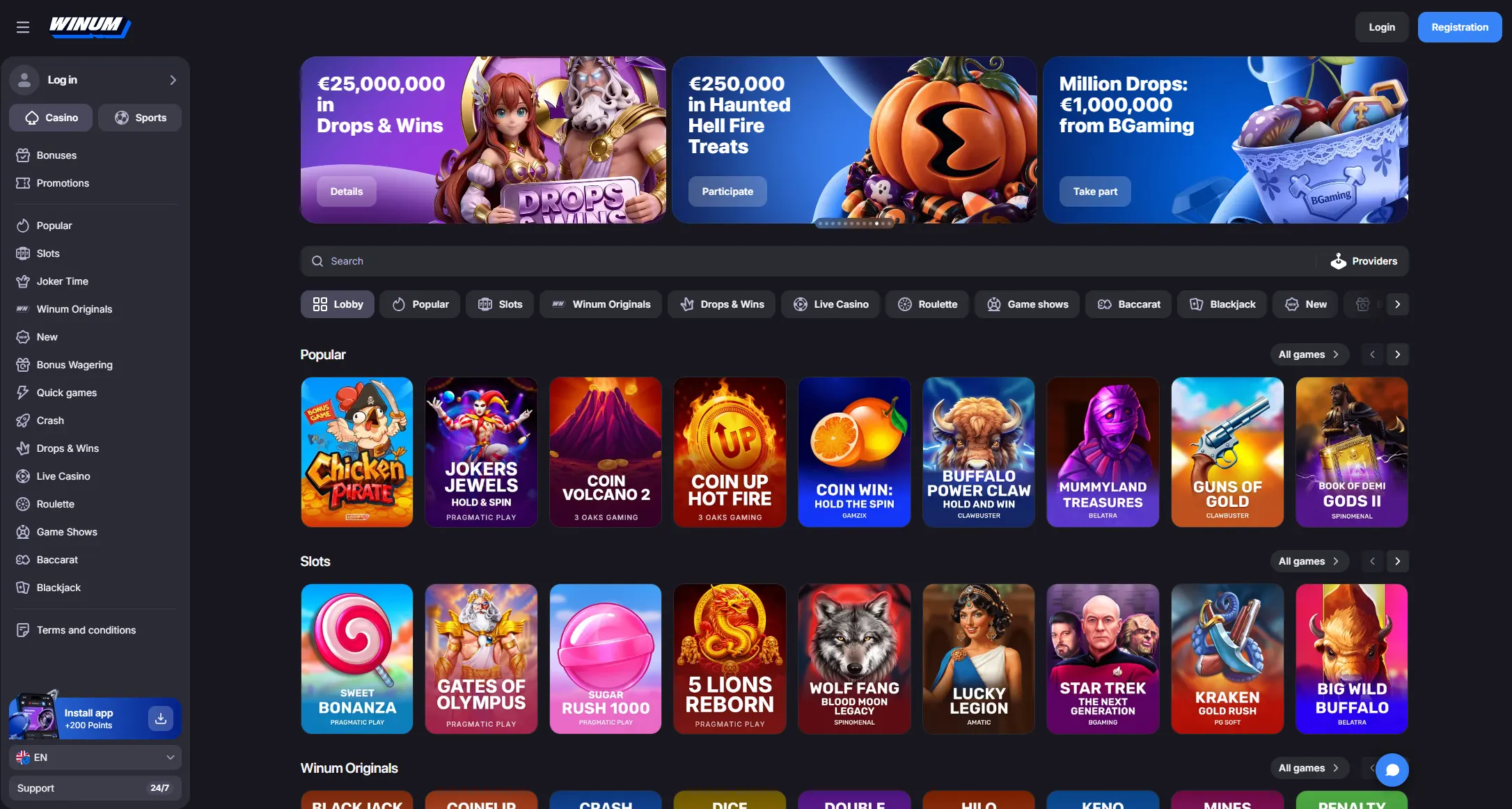
Winum is marketed as an online casino brand. Its public-facing material describes casino games and mobile access. The relevant operator name is Galaxy Byte Lab SRL: it appears both in the brand-facing About page and in the licence register examined for this review. The register connects that entity with a particular domain; it is not a blanket endorsement of everything using the word Winum.
A reader searching the brand may encounter an account service, a promotional site, a regional information page or a review. The crucial identifier is the exact hostname. A familiar logo, an “official” heading or a country-specific page is not a substitute for establishing who controls it.
This resource is an editorial review. Its links to documents are references, not registration or gaming referrals.
Ownership and licence: the record we found
The public licence register contains the following matched fields, accessed on 9 October 2026:
| Field | Register observation |
|---|---|
| Company | Galaxy Byte Lab SRL |
| Licence identifier | ALSI-202508040-FI2 |
| Category | B2C |
| Displayed status | Valid |
| Issue / expiry | 29 August 2025 / 28 August 2027 |
| Relevant listed domain | winum.casino |
The domain list in that entry does not include winum.io, the brand-facing information site whose pages we also inspected. This is a scope limitation, not a finding that the latter domain is fraudulent. A relationship between the sites needs its own evidence.
Three conclusions should remain separate: a record exists; a particular website is connected to that record; the service is permitted in a reader’s country. Confirming the first does not automatically confirm the other two. The Safety article explains the distinction and why licence status cannot predict a payment outcome.
Country editions and local context
A country selector and a reachable website do not establish local permission. The India edition keeps its documentary findings in their original regional context. Legal permission in other countries has not been established by this research.
Choose the appropriate country in the header. The general English version is not directed at the United States.
Winum withdrawals: why an exact time would be misleading
The published terms, clause 8.3.3, do not guarantee an exact processing time. That makes an unqualified “instant withdrawal” headline a poor basis for assessing a disputed request.
For an existing problem, distinguish three stages: a request appears in the account, the provider records it as processed, and the receiving payment system settles it. A timestamp from one stage does not establish when another occurred. This is a way to organise the evidence, not a claim that a particular Winum request passed through all three stages.
| Question in an existing dispute | Evidence that would clarify it |
|---|---|
| Was the request recorded? | Dated account status or acknowledgement |
| Is a decision pending? | Specific explanation and the unresolved requirement |
| Is payment said to be sent? | A verifiable payment reference, not only a support message |
| Was money received? | A matching receiving record, kept privately |
We do not publish a method-specific timetable or a local payment-method list without appropriate evidence. A limit from another country’s page should not be relabelled as a local limit. The withdrawal-problems guide provides a concrete chronology and questions for an existing dispute.
Terms that deserve closer attention
The policy text is useful because it exposes decision points that a marketing summary may omit. One example is clause 10.3 concerning amounts credited in error. Its relevance is not that every transaction is an error; it is that a disagreement may turn on the reason given for an adjustment.
For a disputed adjustment, the relevant questions are which version applies, which clause is invoked, which transaction is affected and what supporting calculation was supplied. Calling a deduction “a policy decision” does not by itself explain the evidence behind it. Equally, disagreement with an adjustment does not by itself prove misconduct.
Contract wording, enforceability and actual conduct are different questions. We analyse the first and leave the latter two to suitable evidence and qualified review. The Safety examination sets out the limits of the current record.
Android APK, iPhone access and a native app are different
The brand-facing mobile page describes Android APK access and browser-based use on iOS. A reference to an APK does not authenticate a file; an iPhone home-screen experience does not establish an App Store application.
| Item to establish | Why it matters |
|---|---|
| Exact product type | A browser page and installed software have different assessment requirements |
| Developer identity | The visible brand name may not identify the software publisher |
| Package / bundle identifier | Distinguishes a specific application from a namesake |
| Distribution source and version | Makes a review reproducible rather than a vague promise |
| Signing identity and permissions | Needed before drawing a conclusion about an installed binary |
No executable was downloaded or tested. Our app-safety article gives a platform-by-platform conclusion and explains which checks remain open. It does not distribute files or publish mirrors.
Reviews and complaints: three original public records
The case analysis examines three original mediation threads: two Nigerian account/payment disputes and an Indonesian sports-betting dispute closed without a merits finding. These are attributable records rather than invented testimonials. They are not a representative sample for any country.
The useful distinction is between a user’s allegation, a platform’s explanation and a finding supported by evidence. Retrieved versions disagree about one case’s status, so we do not report it as a verified current outcome. Neither “unresolved” nor “closed” automatically establishes who was right. Our analysis records those limits and avoids converting three cases into a payout-success percentage.
The sources are the original account-closure thread, payment-delay thread and sports-dispute thread, not another review’s rating. No user profiles or private documents are reproduced.
Our assessment
There is a traceable licence-register observation, but its domain scope must be respected. Published policy wording is more useful than promised payout speeds. The Android and iOS descriptions require different authentication work. None of those findings resolves local legal permission.
The material is therefore an evidence-based assessment of the available documents, not a blanket safety recommendation. The claim register and methodology describe the scope and limitations of each finding.
The next evidence that would materially change this assessment is a verified connection between the exact service domain and the licence holder, an appropriate legal assessment, authenticated mobile-software provenance and attributable dispute records. Each would change its own finding; none should automatically upgrade every aspect of the brand to “trusted”.